Curriculum
Our Curriculum at Barford Primary School
Future Focused. Ambitious. Inclusive.
"Learning today, achieving tomorrow."
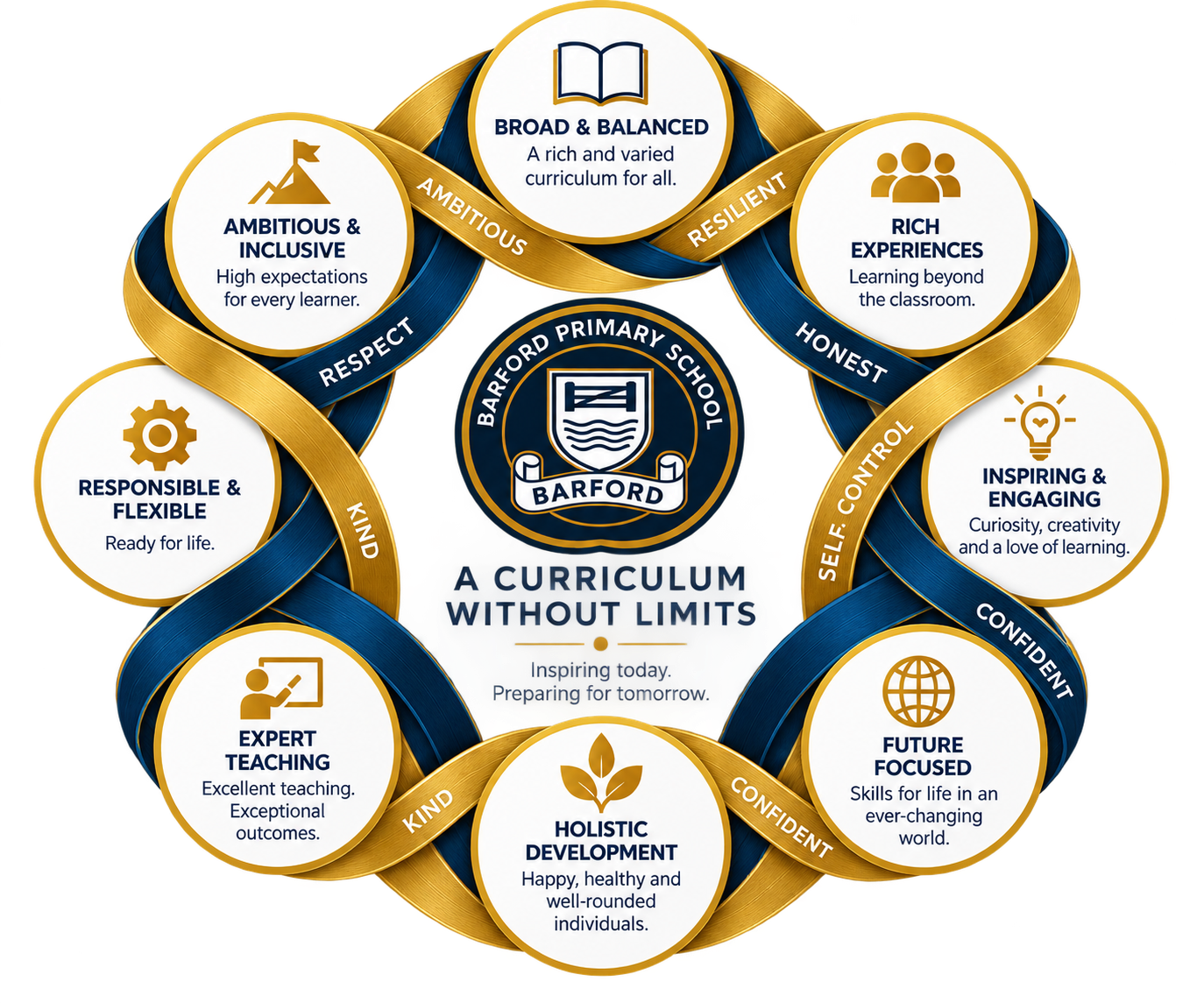
At Barford Primary School, our curriculum has been carefully designed to provide every child with the knowledge, skills and experiences they need to thrive in secondary school, future employment and modern British society. We believe that every child, regardless of their starting point or background, deserves an education that is ambitious, inclusive and inspiring.
Our curriculum reflects both the National Curriculum and the unique needs of our school community. It has been designed around the principle that all children can achieve, with high expectations for every learner and carefully planned support where needed. We want every pupil to leave Barford as a confident, knowledgeable and compassionate individual who is ready for the opportunities and challenges of the future.
Our Curriculum Drivers
Everything we teach is underpinned by our curriculum drivers, which shape learning across every subject.
Future Focused
We prepare children for life beyond Barford by equipping them with the knowledge, skills and character needed for success in an ever-changing world. Children develop independence, resilience, creativity, digital literacy, collaboration and problem-solving alongside strong academic knowledge.
Ambitious
We have high expectations for every pupil. Our curriculum is broad, balanced and carefully sequenced so that all children develop deep knowledge across a wide range of subjects. We believe every child deserves access to rich learning, regardless of background or starting point.
Inclusive
Our curriculum celebrates diversity and ensures that every child feels represented, valued and included. Learning reflects the cultures, languages, experiences and identities of our school community while introducing children to the wider world. We remove barriers to learning so that every pupil can succeed.
Bespoke
Our curriculum has been designed specifically for Barford Primary School. It responds to our local context, our pupils and our community. We adapt and enrich the curriculum to ensure learning is meaningful, relevant and memorable.
Examples include:
- Swimming from Year 1 to Year 6 because of our proximity to Edgbaston Reservoir and Birmingham's canal network.
- A strong emphasis on reading and vocabulary to support our multilingual community.
- Rich educational visits and visitors that broaden children's life experiences.
- Learning opportunities that celebrate Birmingham's history, culture and diversity.
- Opportunities to develop cultural capital through music, sport, art, science and outdoor learning.
Building Knowledge Over Time
Our curriculum has been carefully sequenced so that knowledge builds progressively from the Early Years Foundation Stage through to Year 6.
Children are introduced to the most important knowledge first before gradually applying, connecting and extending their understanding.
We believe that children learn best when they remember more and know more over time. Every subject has been planned so that new learning deliberately builds upon prior knowledge, allowing pupils to make meaningful connections across concepts and develop increasingly sophisticated understanding.
Teachers regularly revisit previously taught content through retrieval practice, discussion and purposeful application, ensuring knowledge moves into long-term memory.
The Importance of Early Years
Learning begins in the Early Years Foundation Stage, where children develop the essential foundations that underpin future success.
Our EYFS curriculum places a strong emphasis on:
- Communication and language
- Early reading through systematic synthetic phonics
- Early mathematics
- Physical development
- Personal, social and emotional development
- Curiosity and exploration
These foundations provide children with the vocabulary, confidence and knowledge needed to access the wider curriculum as they move through school.
Strong foundations in Reception enable children to become increasingly independent learners who are ready for the demands of Key Stage 1 and beyond.
Substantive and Disciplinary Knowledge
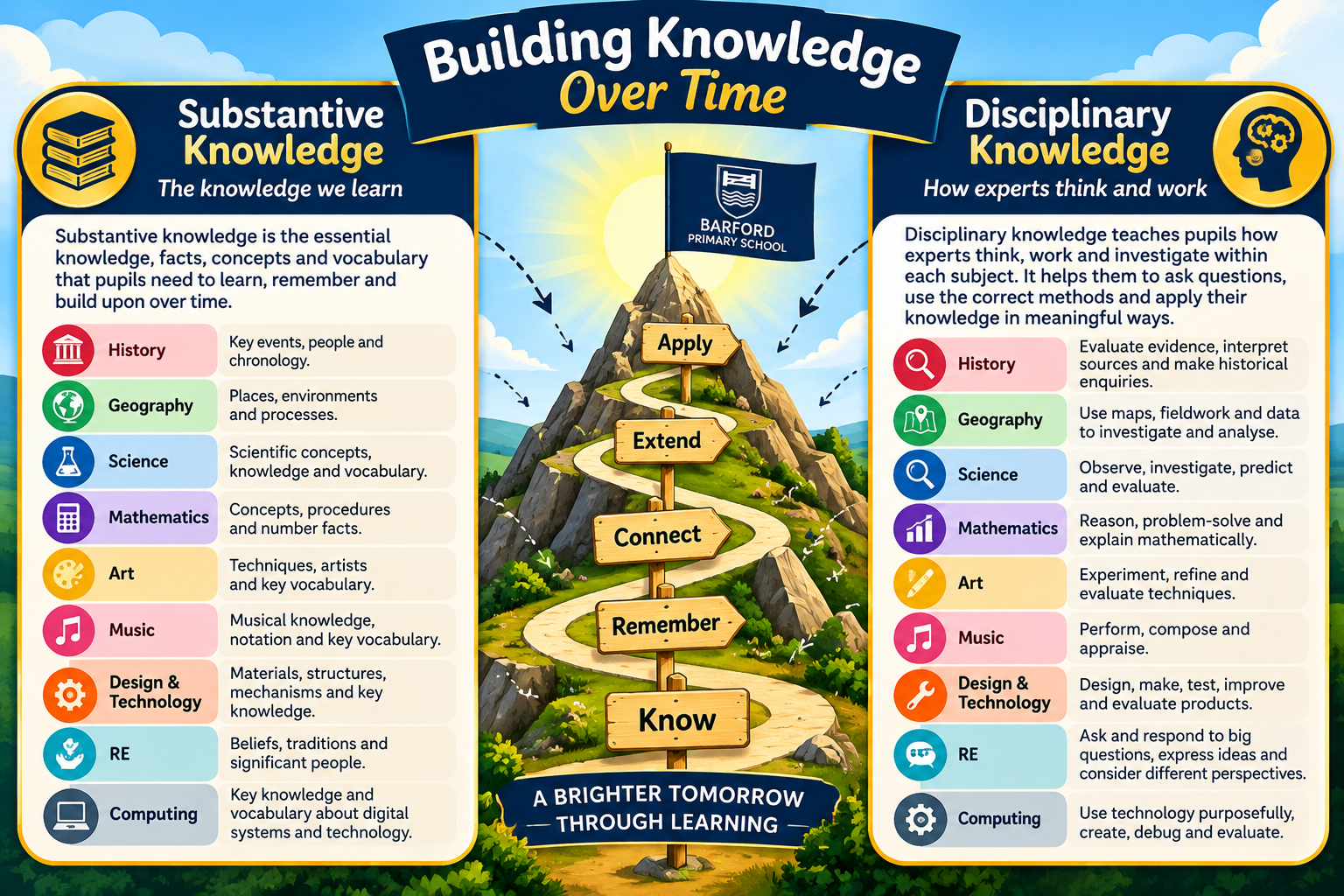
Across every subject, our curriculum develops both substantive knowledge and disciplinary knowledge.
Substantive Knowledge
This is the essential knowledge that pupils need to learn, remember and build upon over time. It includes the important facts, concepts, vocabulary and content within each subject.
For example:
- Historical events and chronology in History.
- Scientific concepts in Science.
- Geographical processes in Geography.
- Mathematical concepts and procedures in Mathematics.
- Artistic techniques and influential artists in Art.
- Musical knowledge and notation in Music.
Children revisit this knowledge regularly so that it becomes embedded in their long-term memory.
Disciplinary Knowledge
Disciplinary knowledge teaches children how experts think and work within each subject.
For example:
- Historians evaluate evidence and interpret sources.
- Scientists investigate, observe, predict and evaluate.
- Geographers analyse maps, fieldwork and data.
- Artists experiment, refine and evaluate techniques.
- Musicians perform, compose and appraise.
- Designers create, test, improve and evaluate products.
Developing disciplinary knowledge enables children to think critically, ask meaningful questions and apply their knowledge in increasingly sophisticated ways.
Learning That Lasts
Our curriculum is carefully planned so that children revisit important concepts throughout their time at Barford.
This enables pupils to:
- know more
- remember more
- make stronger connections between ideas
- apply learning confidently in new contexts
- develop increasingly secure understanding over time
Rather than viewing subjects as isolated areas of learning, children recognise how knowledge connects across the curriculum.
Rich Experiences and Cultural Capital
We believe some of the most powerful learning happens beyond the classroom.
Every year group benefits from carefully planned enrichment opportunities that deepen learning and create lasting memories.
These include:
- Educational visits linked directly to curriculum learning.
- Residential experiences.
- Visitors and expert workshops.
- Sporting competitions.
- Performing arts opportunities.
- Outdoor learning.
- STEM activities.
- Enterprise projects.
- Community partnerships.
- Celebration events.
- Leadership opportunities.
These experiences ensure every child develops the cultural capital needed to succeed in education and later life.
Representation and Diversity
Our curriculum reflects the rich diversity of Barford Primary School and modern Britain.
Children learn about significant individuals, cultures, faiths and communities from across the world through books, resources, discussions and the wider curriculum.
We ensure pupils see themselves represented within their learning while also developing respect, understanding and appreciation for people whose experiences may differ from their own.
By celebrating diversity and promoting equality, we prepare children to become respectful, compassionate and active citizens.
Expert Teaching
High-quality teaching is at the heart of our curriculum.
Teachers:
- have strong subject knowledge
- use carefully sequenced lessons
- revisit prior learning regularly
- explicitly teach vocabulary
- check understanding continually
- address misconceptions swiftly
- adapt learning to meet individual needs
- provide appropriate support and challenge
Assessment informs teaching, ensuring all pupils make sustained progress through the curriculum.
Our Curriculum Impact
By the time pupils leave Barford Primary School, they have developed the knowledge, skills and personal qualities needed for the next stage of their education and beyond.
Our children leave us as:
- confident readers, writers and mathematicians
- curious scientists, historians and geographers
- creative artists, musicians and designers
- healthy, active and resilient individuals
- respectful and responsible citizens
- confident communicators
- ambitious learners
- compassionate members of their community
Most importantly, they leave Barford having learned more, remembered more and become more, equipped with the confidence, knowledge and character to flourish in secondary school and throughout their lives.